
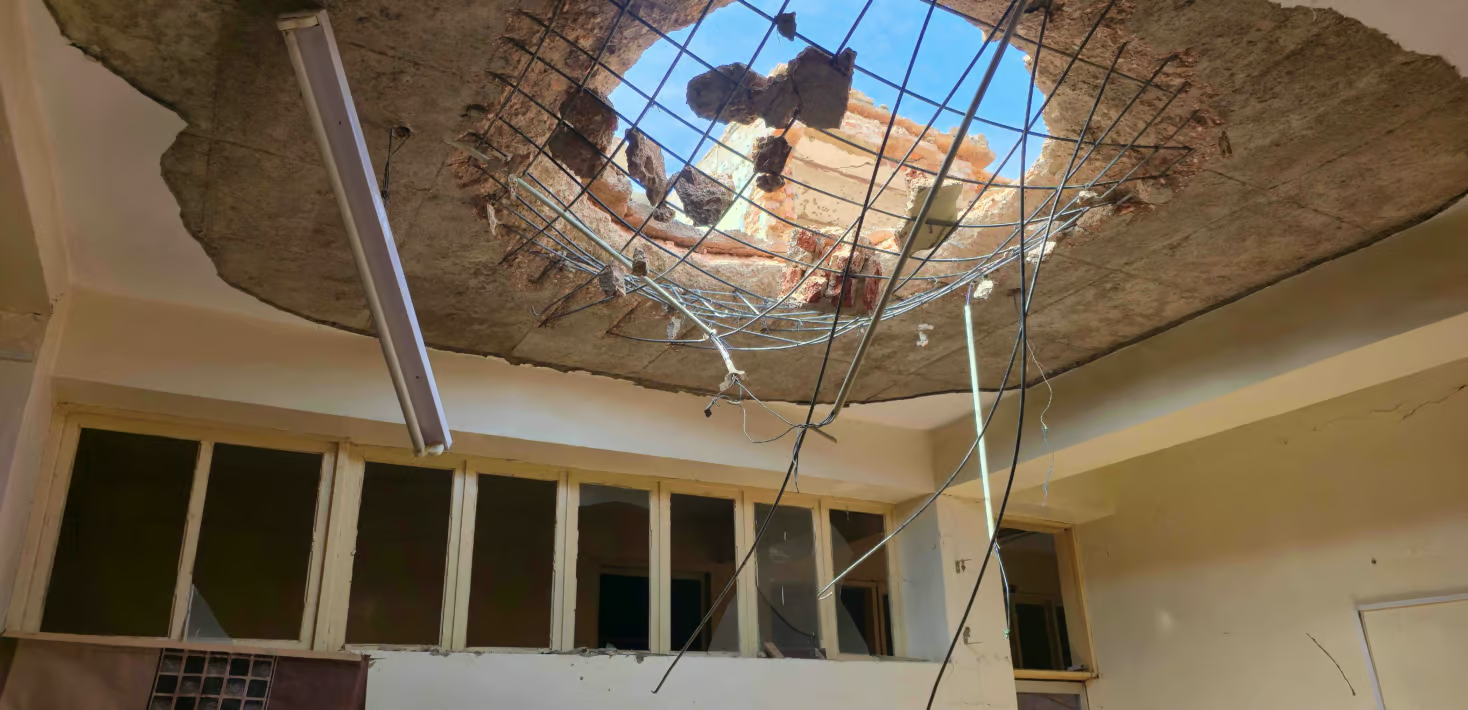
Drone strikes by Rapid Support Forces (RSF), which hit residential areas and civilian infrastructure in El Obeid city, in Sudan’s North Kordofan State, killing dozens and disrupting essential services, should be investigated as war crimes, Amnesty International said today.
The organization investigated nine RSF drone strikes in El Obeid and its surroundings, which killed 37 civilians and injured 10 between June and August 2026. Three of the strikes hit residential areas; four struck key civilian infrastructure, including El Obeid’s power plant, fuel stations, and the main market; and two targeted moving vehicles. In all incidents, interviewees said they either saw or heard the drones, moments before or after the strikes. Amnesty International’s investigation did not identify military objectives in the vicinity of the sites at the time they were struck.
El Obeid, the capital of North Kordofan State, remains under the control of the Sudanese Armed Forces (SAF) and their allied forces. The RSF first launched drone attacks in the city in October 2025 and continued intermittent attacks in the following months. In June 2026, the RSF dramatically escalated its drone strikes on El Obeid as it reportedly prepared to launch a ground offensive on the city – raising fears that the atrocities committed when it seized El Fasher a year ago would be repeated.
“The RSF drone attacks we’ve documented must be investigated as war crimes. They indicate how the Sudan conflict is moving into a new phase where all parties are increasingly using drones and other advanced weapons not only to kill and injure civilians, but also to disrupt essential and lifesaving services,” said Agnès Callamard, Amnesty International’s Secretary General.
“There is no time to wait. With deadly drone attacks on civilians on the rise, immediate action is needed. The UN and the African Union must urgently work together to propose and implement concrete civilian protection measures, including deployment of a protection force to Sudan.”
Amnesty International has previously documented how the United Arab Emirates (UAE) supplied weapons, ammunition, armored personnel carriers, and drones to the RSF. The organization also found that the RSF used Chinese drones including Wing Loong II and FeiHong-95, both of which have been provided by the UAE.
“This is a war on civilians which is being sustained by third parties including the UAE, the primary backer of the RSF. All those manufacturing and supplying drones and other military equipment to the warring parties must immediately cease doing so. The UN Security Council must also extend the arms embargo covering Darfur to the rest of the country and ensure that drones are included as part of the military materiel subject to the Sudan arms embargo,” said Agnès Callamard.
Between July and September 2026, Amnesty International interviewed 29 people from El Obeid including victims, relatives of victims, eyewitnesses and residents. The organization has also analyzed five photos and videos and reviewed satellite imagery and various reports of humanitarian and UN agencies.
On October 8, Amnesty International wrote to the RSF about the findings of this investigation. The RSF responded on October 24, denying and deflecting responsibility for attacks resulting in civilian casualties in El Obeid to the SAF, but without providing any evidence supporting its allegation. Nevertheless, the RSF said that it was considering establishing a “Specialized Investigative Committee” to “examine incidents involving civilian casualties or destruction of civilian property, including those… concerning El Obeid” and that it would “seek to strengthen compliance with legal procedures governing the verification of military objectives.”
Civilian casualties from drone strikes hitting residential areas
On June 10, 2026, an RSF drone strike hit civilians carrying a body for burial at the Dalil cemetery in the north-west of El Obeid, killing at least five people and injuring three others. Those killed included Ahmed Issa and Moatasim Ahmed Issa, the respective father and brother of 25-year-old Al Nur Ahmed Issa, who was himself killed in a separate drone strike that morning.
A 19-year-old “muadhin” (a person who makes the Islamic call to prayer) at one of the local mosques was seriously injured in the attack. He said: “I was with others in the vehicle. I saw a drone circling above us just after we entered the Dalil Cemetery. And within seconds, we were struck by something that came from the drone. I was sitting at the rear part of the vehicle and was blown out to the roadside… We were engulfed by smoke and dust, but I could see the body parts of those who were with me in the car scattered all over. We came to bury our neighbor, but more of my friends and neighbors ended up dead and injured.”
On June 11, the RSF launched drone attacks on several neighborhoods including Al-Matar and Al-Muwazzafin. One of these strikes hit a residential home in Al-Matar, killing at least 9 civilians.
“We heard two large explosions at around 2:20am. My husband and I came out and saw one of our rooms burning. We took out our four children who were crying and traumatized. Many neighbors came out to put out the fire in our house and then the drone dropped another bomb that killed my husband, my uncle and seven neighbors. I don’t know why we were targeted,” said the owner of the house, a 41-year-old doctor.
On August 12, an RSF drone strike hit the Agricultural Bank near El Obeid’s main market killing two civilians, a 52-year-old woman, Zeinab Babu, and a man, Ahmed Salah Awad, and injuring five others. According to two relatives, Zeinab was at the entrance of the bank when shrapnel hit her head, killing her instantly.
An internally displaced woman who was also injured in the attack said: “I was begging the bank customers for assistance, but I was hit by a shrapnel on my left knee. I was taken to the El Obeid Teaching Hospital alongside four other men who were also injured in the attack.”
Attacks on civilian infrastructure
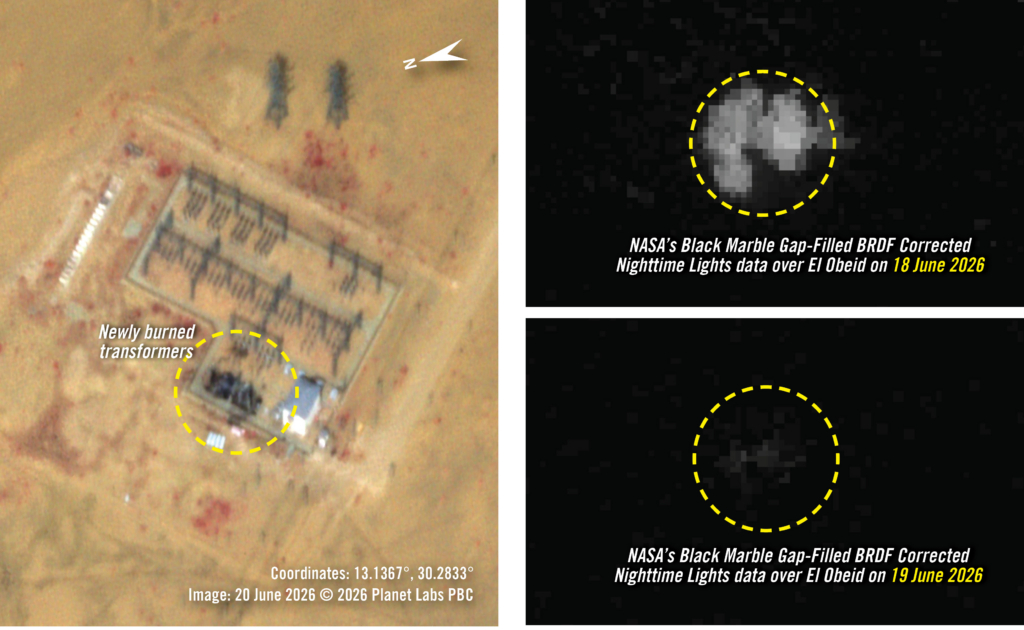
On June 18, an RSF drone strike hit El Obeid’s main electricity station, sparking a fire which caused a city-wide power blackout. Satellite imagery from June 20 confirms a newly visible burn area on the north-western edge of the facility. NASA’s Nighttime Lights data also shows a significant decrease in radiance over El Obeid on June 19. While the strike did not result in civilian casualties, residents and humanitarians said it exacerbated an already chronic water and food crisis in the city. According to the UN Fact-Finding Mission, attacks affecting electricity in El Obeid disrupted water services and forced residents to reduce water consumption.
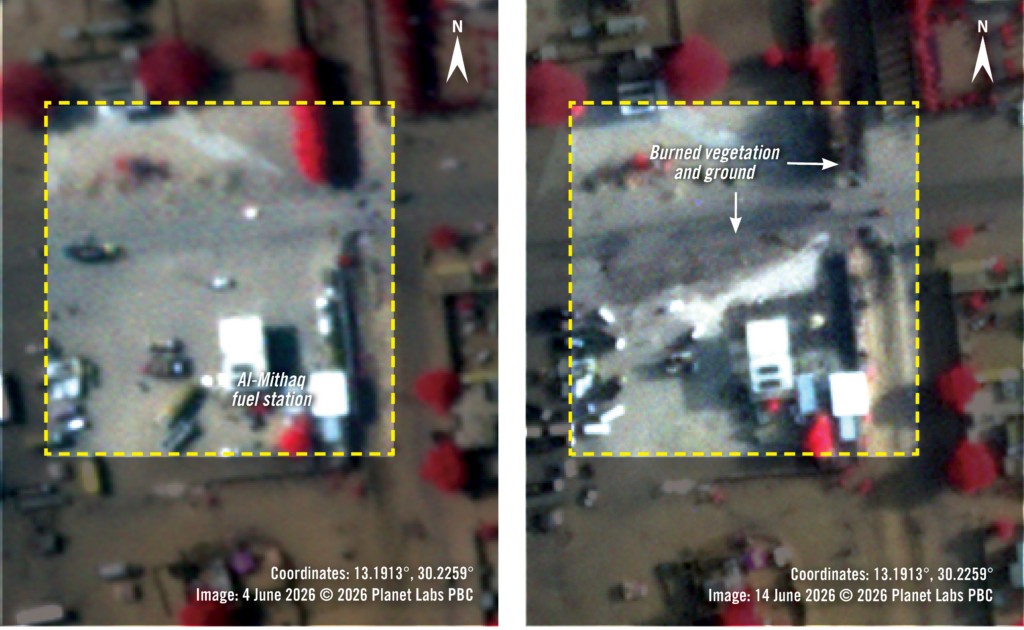
RSF drone strikes repeatedly targeted several fuel stations across El Obeid in June and July 2026.
On June 6, an RSF drone struck Al-Mithaq fuel station, near the Omdurman bus terminal, killing at least five civilians and destroying several civilian vehicles. Amnesty International verified a video posted on YouTube on June 6 showing the immediate aftermath of the strike. Filmed from across the street, it shows large plumes of smoke rising from the fuel station and several people in civilian clothing in the vicinity, including at least four children. Satellite imagery from June 7 further confirms a burn mark is visible north of the fuel station.
On June 22, an RSF drone strike hit the al-Nahla fuel station in north El Obeid, killing two civilians and burning five civilian vehicles queueing for fuel inside the station. One of the civilians killed in the attack was 30-year-old charcoal trader Abdulrahim Mohammed Ibrahim, who was hit by a fragment at the entrance of the fuel station. His brother told Amnesty International he collected Abdulrahim’s body from the scene later that evening.
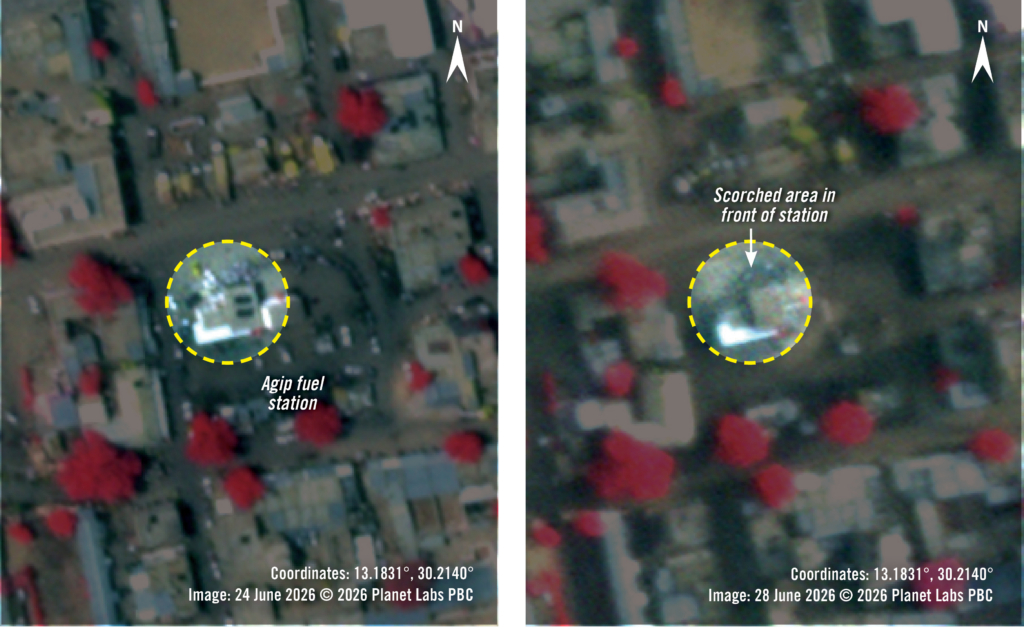
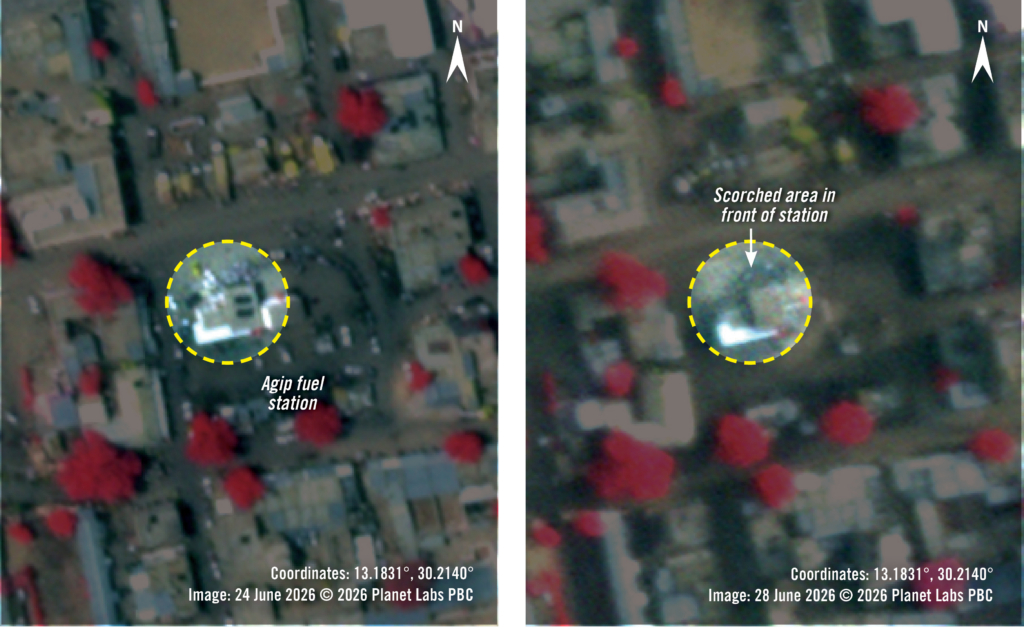
Another drone strike hit the Agip fuel station in the western market area on June 25. While no civilian casualties were reported, the strike destroyed 10 civilian vehicles parked in the vicinity of the station. Amnesty International verified an image posted on Instagram on June 26 that shows the aftermath of the strike. The image shows people gathered around at least four burned cars, while the damage and burning marks are also visible at the nearby building. Satellite imagery from June 28 confirms new burn marks and objects visible north of the station.
In July, Médecins Sans Frontières assessed that there were almost no remaining functional fuel stations in El Obeid and the price of one litre of gasoline had reached nearly $15 USD and possibly even higher on the black market.
Attacks targeting commercial trucks and other convoys
On June 10, a drone strike hit a truck on the El Obied-Al Rahad road as it was transporting food supplies to Kadugli city in South Kordofan. The attack killed Al-Amin Musa, a trader from El Obeid, and injured two others.
On July 6, another drone strike hit a vehicle carrying wedding guests near al-Sha’toot, a village south of Jabratal Sheikh locality, killing 13 civilians.
“The RSF must immediately cease all drone attacks on civilians and civilian infrastructure. The UN, African Union, EU, Intergovernmental Authority on Development, Arab League, US, UK, UAE and others with influence over the warring parties must all do everything in their power to secure an immediate ceasefire and strengthen existing accountability mechanisms,” said Agnès Callamard.
Background
RSF has laid a partial siege on El Obeid city for nearly two years now in an attempt to seize it from SAF. El Obeid strategically sits on a vital transit and highway hub connecting the western regions controlled or contested by the RSF to the eastern and central regions held by the SAF.
The Sudan conflict is now marked by an increase in the use of armed drones. According to the Office of the United Nations High Commissioner for Human Rights OHCHR, in the first six months of 2026, at least 1,120 civilians were killed by drone strikes, accounting for 80 percent of all conflict-related civilian deaths recorded by the office in 2026. While this investigation is focused on RSF drone strikes in El Obeid, Amnesty International is currently investigating SAF drone strikes that have also resulted in civilian causalities.
Contact: [email protected]